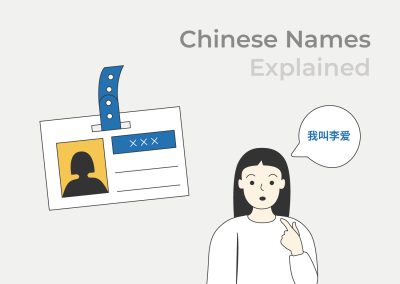
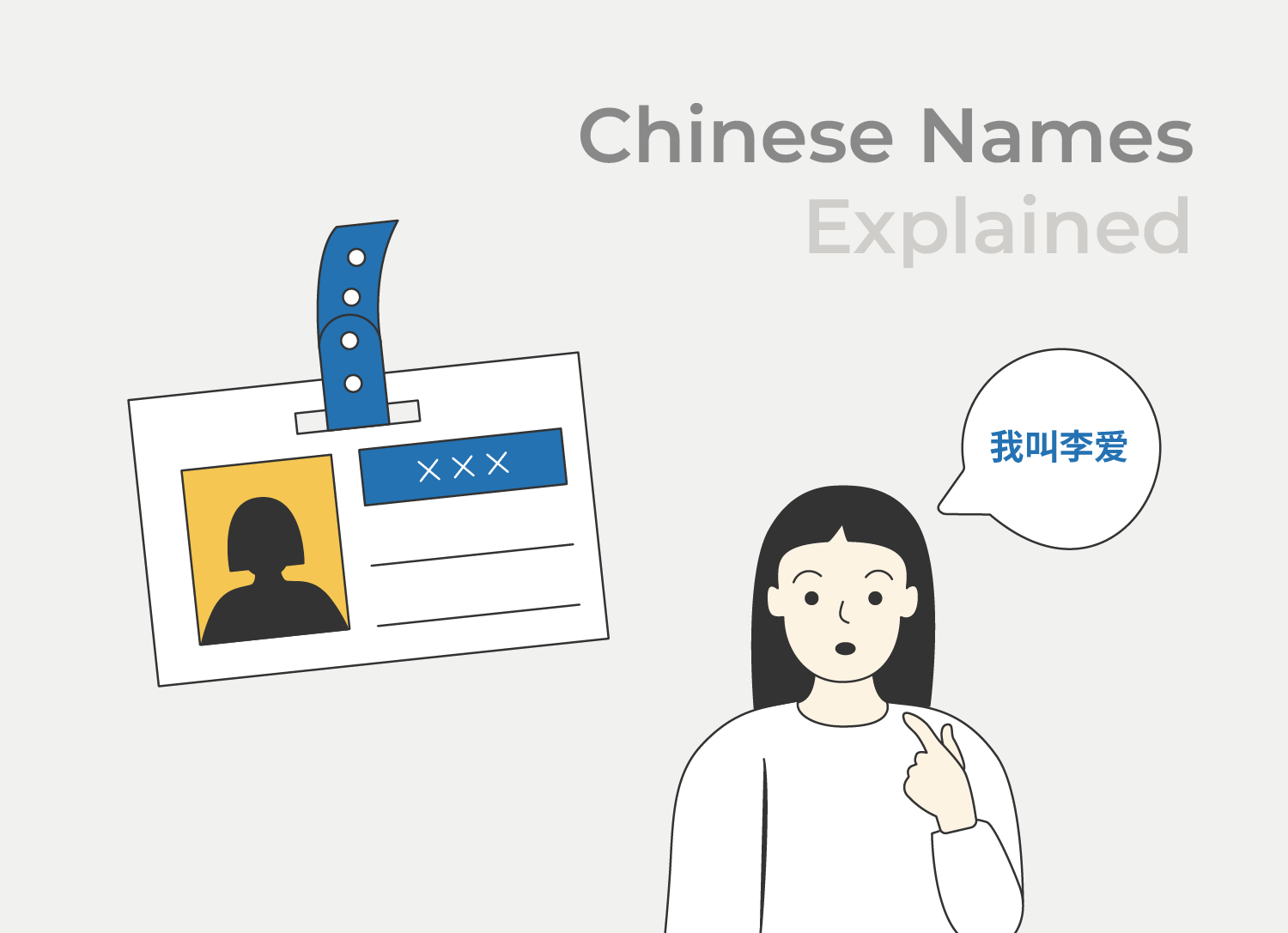
Chinese names can look unfamiliar at first, but the basic structure is quite straightforward. In most cases, a Chinese name consists of a family name (surname) followed by a given name.
For example, 王伟 (Wáng Wěi) has 王 (Wáng) as the family name and 伟 (Wěi) as the given name. This is different from the naming order commonly used in English, where the given name usually comes first.
Chinese names are also closely connected to language and culture. The characters chosen for a given name can carry particular meanings, while family names can reflect a person’s ancestry and family identity.
If you’re learning Mandarin, understanding Chinese naming conventions can make it easier to introduce yourself, address other people, and understand how names are written and pronounced.
Key Takeaways
- Chinese names generally place the family name before the given name.
- Most Chinese surnames consist of one character, although two-character surnames also exist.
- Given names can consist of one or two characters.
- Chinese characters used in names often have particular meanings or associations.
- Naming choices can reflect family traditions, cultural values, and hopes for a child.
- Some Chinese people use an English name in international or English-speaking settings.
How Do Chinese Names Work?
The basic structure of a Chinese name is usually:
Family name + Given name
For example:
李明 (Lǐ Míng)
- 李 (Lǐ) — family name
- 明 (Míng) — given name
This is different from the order commonly used in English, where the given name usually comes before the family name.
Chinese given names can contain one or two characters. The characters are chosen for their sound, meaning, and cultural associations, rather than simply because they correspond to an English name.

Chinese Name Order
In Chinese, the family name normally comes first. For example:
王伟 (Wáng Wěi)
Here, 王 (Wáng) is the surname and 伟 (Wěi) is the given name.
When Chinese names are written in English, the order can sometimes change depending on the person’s preference or the context. You may therefore see the same person listed as Wang Wei or Wei Wang.
When in doubt, use the name in the format the person uses themselves.
How Long Are Chinese Names?
Most Chinese surnames consist of one character, while the given name usually contains one or two characters.
For example:
张伟
Zhāng Wěi
one-character surname + one-character given name
欧阳娜娜
Ōuyáng Nànà
two-character surname + two-character given name
Two-character surnames such as 欧阳 (Ōuyáng) are less common than single-character surnames, but they are an established part of Chinese naming traditions.
The number of characters alone does not tell you whether something is a surname or given name, so learning common surnames can be helpful when reading Chinese names.
Chinese Surnames and Family Names
Chinese surnames are an important part of a person’s family identity and ancestry. The Chinese word for surname is 姓 (xìng).
Most Chinese surnames consist of a single character. Some of the most common include:
| chinese | pinyin |
|---|---|
| 王 | Wáng |
| 李 | Lǐ |
| 张 | Zhāng |
| 刘 | Liú |
| 陈 | Chén |
| 杨 | Yáng |
These characters are not simply chosen by parents when a child is born. In most cases, a person’s surname is inherited through their family.
There are also two-character surnames, although they are much less common. One well-known example is 欧阳 (Ōuyáng).
What Do Chinese Surnames Mean?
Some Chinese surnames have meanings that can be traced to ordinary Chinese words, while others have origins in ancient places, occupations, titles, clans, or historical figures.
For example, 王 (Wáng) means “king” or “ruler” as an ordinary Chinese word. However, a person’s surname 王 does not necessarily mean that their family is connected to royalty.
The history of Chinese surnames is much more complicated than simply translating the characters into English.
The Hundred Family Surnames
One famous traditional text associated with Chinese surnames is 百家姓 (Bǎijiāxìng), commonly translated as The Hundred Family Surnames.
Despite its name, the text contains far more than 100 surnames. It is a traditional collection of Chinese family names that was widely used for teaching and memorisation.
Today, it remains a useful cultural reference for understanding the long history of Chinese surnames.
Chinese Given Names and Their Meanings
The given name comes after the family name in the standard Chinese naming order.
For example, in 李明 (Lǐ Míng), 李 is the surname and 明 is the given name.
Given names are often chosen because of the meaning, sound, or associations of the characters.
Parents may choose characters connected with qualities they hope their child will have, such as:
- Wisdom
- Kindness
- Strength
- Happiness
- Success
- Beauty
- Good fortune
Names can also draw inspiration from nature, literature, history, or traditional values.
However, a Chinese name usually has meaning as a combination of characters, rather than simply being a direct translation of each character.
For this reason, translating a Chinese name word-for-word does not always capture what the name means to the person or their family.
Chinese Naming Traditions
Chinese naming practices have developed over centuries and can vary between families and generations.
One traditional practice is the use of a generation name, where members of the same generation in a family share one character in their given names.
For example, siblings or cousins may have different given names but share one character that identifies their generation.
Not every family follows this practice today, and modern naming choices can be much more individual.
Names may also reflect changing social trends. Parents today can choose characters based on traditional values, modern preferences, literature, nature, or simply the sound they like.
There is therefore no single formula for creating a Chinese name. Naming practices can vary considerably between families, regions, and generations.
Chinese Name Order and How to Address Someone
Understanding Chinese name order is especially useful when studying or working in China. In most situations, the family name comes before the given name.
For example:
王老师
Wáng lǎoshī
Teacher Wang
李医生
Lǐ yīshēng
Doctor Li
Using a person’s surname together with a title or professional role is a common and polite way to address someone in formal situations.
Other titles can also be used depending on the person’s role or relationship to you.
Using Someone’s Given Name
Whether you use someone’s given name depends on your relationship with them.
In more formal situations, using a title and surname can be more appropriate. Among friends and people who know each other well, using a given name may be more natural.
If you’re unsure, it is generally best to follow the way the person introduces themselves or addresses others.
Chinese Names in English
Chinese names can appear in different formats when written in English. For example, the Chinese name:
王伟
Wáng Wěimay be written as Wang Wei
Some people may instead present their name as: Wei Wang
This can depend on personal preference, official documents, the country they are living in, or the context in which the name is being used.
Some Chinese people also choose an English given name when studying or working in an English-speaking environment.
For example, someone named 王伟 (Wáng Wěi) might introduce themselves using an English given name alongside their Chinese surname.
There is no single rule that applies to everyone. When addressing someone, the safest approach is to use the name and order that they personally use.
How to Choose a Chinese Name
If you’re learning Mandarin or planning to spend time in China, you may eventually want to choose a Chinese name of your own.
A good Chinese name should sound natural and have a meaning that you are comfortable with.
Think About the Meaning
Start by considering what you want your name to express.
You might choose characters associated with qualities such as wisdom, kindness, confidence, or happiness.
Consider the Pronunciation
The characters should sound natural when combined with your surname.
This is particularly important for learners, as a combination that looks good on paper may sound unusual when spoken.
Check the Characters
Don’t choose characters based only on their individual meanings.
Two characters can have positive meanings separately but create an unusual or unintended meaning when placed together.
Consider Cultural Associations
Some characters may have associations that are not obvious to non-native speakers.
A character could be strongly associated with a particular generation, historical figure, literary work, or traditional expression.
Ask a Native Speaker
If you’re unsure whether a name sounds natural, ask a native Mandarin speaker or Chinese teacher for their opinion.
They can help you check the pronunciation, meaning, and overall impression of the name.
Choosing a Chinese name is not about finding the most complicated or impressive characters. A name that is natural, meaningful, and easy to use is often a better choice.
Popular Chinese Names
Chinese given names can vary by generation, region, and personal preference, so there is no single list of names that represents everyone.
If you’re looking for inspiration, we’ve put together separate guides covering popular Chinese girl names and popular Chinese boy names, including their meanings and cultural context.
Useful Chinese Vocabulary for Names
If you’re learning Mandarin, these words are useful when talking about names and introducing yourself.
| chinese | pinyin | english |
|---|---|---|
| 名字 | míngzi | name |
| 姓 | xìng | surname / family name |
| 名 | míng | given name |
| 全名 | quánmíng | full name |
| 家庭 | jiātíng | family |
| 辈 | bèi | generation |
| 汉字 | hànzì | Chinese character |
| 意思 | yìsi | meaning |
| 叫 | jiào | to be called |
你叫什么名字?
Nǐ jiào shénme míngzi?
What is your name?
A natural response is:
我叫王伟。
Wǒ jiào Wáng Wěi.
My name is Wang Wei.