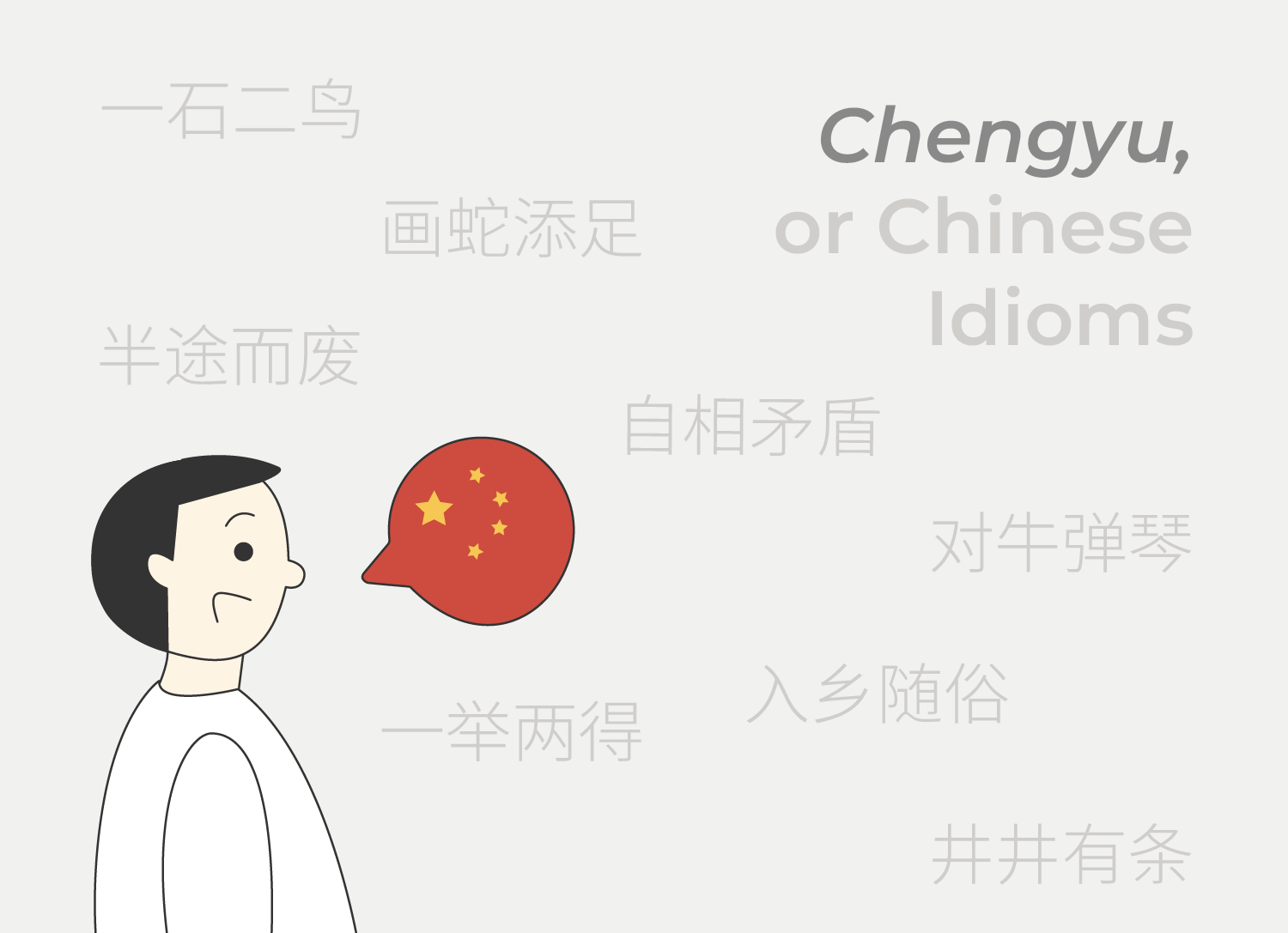
Chinese has a rich tradition of idioms and sayings, many of which appear in everyday conversations, books, films and news.
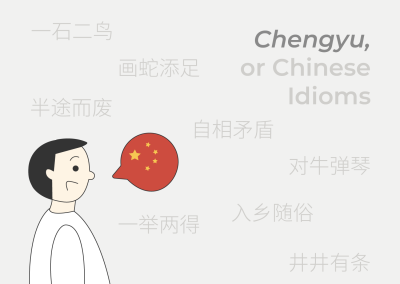
One of the most common types is 成语 (chéngyǔ), or established Chinese idioms. Many chengyu are made up of four characters and express an idea in a short, memorable way.
For Mandarin learners, chengyu can sometimes be confusing because their meaning is not always obvious from the individual characters. Understanding the expression as a whole is often more useful than translating it word by word.
For example, 画蛇添足 (huà shé tiān zú) literally means “draw a snake and add feet”. Its actual meaning is to ruin something by adding something unnecessary.
In this guide, we’ll look at some common Chinese idioms, their meanings, pinyin and examples of how they can be used in context.
What Is a Chengyu?
成语 (chéngyǔ) refers to established expressions that have become part of the Chinese language.
Many well-known chengyu consist of four characters, although not every four-character expression is a chengyu.
Chengyu often come from historical events, classical literature, Chinese mythology and folklore or philosophical ideas. Their short form allows a relatively complex idea to be expressed in just a few words.
This is why knowing common chengyu can be useful for Mandarin learners. Once you understand the meaning behind an expression, you may start recognising it in conversations, books, films and other Chinese-language content.
成语
chéngyǔ
chengyu (idiom)
10 Common Chinese Idioms You Should Know
The best way to learn chengyu is to see them in context. The following expressions are commonly encountered and are useful starting points for Mandarin learners.
一石二鸟 (yìshí-èrniǎo)
literal meaning
One stone, two birds
meaning
To achieve two things with one action; similar to “kill two birds with one stone”.
example
学中文可以一石二鸟。
Xué Zhōngwén kěyǐ yìshí-èrniǎo.
Learning Chinese can help you achieve two things at once.
画蛇添足 (huàshé-tiānzú)
literal meaning
Draw a snake and add feet
meaning
To do something unnecessary that makes a situation worse.
The expression comes from a traditional story about people competing to draw a snake. One person finished first but added feet to his drawing, ultimately losing the competition.
example
你已经做得很好了,不要画蛇添足。
Nǐ yǐjīng zuò de hěn hǎo le, bú yào huàshé-tiānzú.
You’ve already done a good job, so don’t add unnecessary details.
对牛弹琴 (duìniú-tánqín)
literal meaning
Play the qin to a cow
meaning
To explain something to someone who cannot understand or appreciate it.
The expression is often used when someone’s efforts to explain something are completely wasted on their audience.
example
跟他解释这些理论,就像对牛弹琴。
Gēn tā jiěshì zhèxiē lǐlùn, jiù xiàng duìniú-tánqín.
Explaining these theories to him is like playing music to a cow.
半途而废 (bàntú’érfèi)
literal meaning
Stop halfway
meaning
To give up halfway through something.
This is a useful chengyu for talking about studying, work or any long-term goal.
example
学习中文不能半途而废。
Xuéxí Zhōngwén bùnéng bàntú’érfèi.
You shouldn’t give up halfway when learning Chinese.
自相矛盾 (zìxiāng-máodùn)
literal meaning
Spear and shield contradict each other
meaning
To contradict oneself or for two statements to contradict each other.
The expression comes from a story about a merchant who claimed that his spear could pierce anything while his shield could withstand anything.
example
你刚才说的话有点自相矛盾。
Nǐ gāngcái shuō de huà yǒudiǎn zìxiāng-máodùn.
What you just said is a little contradictory.
入乡随俗 (rùxiāng-suísú)
literal meaning
Enter a village and follow its customs
meaning
To adapt to the customs of the place you are visiting; similar to “when in Rome, do as the Romans do”.
example
来到中国以后,我们应该入乡随俗。
Láidào Zhōngguó yǐhòu, wǒmen yīnggāi rùxiāng-suísú.
After coming to China, we should respect and follow local customs.
井井有条 (jǐngjǐng-yǒutiáo)
literal meaning
Orderly and well-organized
meaning
Very organized, orderly or well-structured.
You can use this expression to describe someone’s work, a room, a plan or another well-organized situation.
example
她把工作安排得井井有条。
Tā bǎ gōngzuò ānpái de jǐngjǐng-yǒutiáo.
She organized the work very efficiently.
乱七八糟 (luànqībāzāo)
literal meaning
A complete mess
meaning
Messy, chaotic or disorganized.
Unlike some more formal chengyu, 乱七八糟 is commonly used in everyday Mandarin.
example
我的房间太乱七八糟了。
Wǒ de fángjiān tài luànqībāzāo le.
My room is such a mess.
息息相关 (xīxī-xiāngguān)
literal meaning
Closely connected
meaning
Closely related or interconnected.
This expression is particularly useful when discussing ideas, people or situations that have a strong connection to each other.
example
语言和文化息息相关。
Yǔyán hé wénhuà xīxī-xiāngguān.
Language and culture are closely connected.
一举两得 (yìjǔ-liǎngdé)
literal meaning
One action, two gains
meaning
To accomplish two things with one action; similar to “kill two birds with one stone”.
example
骑自行车上班既环保又锻炼身体,真是一举两得。
Qí zìxíngchē shàngbān jì huánbǎo yòu duànliàn shēntǐ, zhēnshi yìjǔ-liǎngdé.
Cycling to work is environmentally friendly and good exercise — it’s a win-win.
How to Learn Chinese Idioms
Learning chengyu is easier when you focus on meaning and context, rather than trying to memorise long lists.
Learn the Story
Understanding the story behind an idiom can make its meaning much easier to remember.
For example, knowing the story behind 画蛇添足 makes the idea of “adding something unnecessary” much more memorable.
Learn Them in Context
Try to learn each idiom alongside a complete Chinese sentence.
This helps you understand not only what the expression means, but also when and how it is naturally used.
Start with Useful Idioms
You don’t need to memorize hundreds of chengyu.
Start with expressions that you are likely to encounter in everyday conversations, Chinese media, books and lessons. Once these become familiar, you can gradually add more.
Pay Attention to Register
Not every chengyu sounds equally natural in casual conversation.
Some, such as 乱七八糟, are common in everyday Mandarin, while others may sound more formal, literary or written.
Learning the context in which an idiom is normally used is just as important as learning its translation.
Chinese Idioms vs Chinese Sayings
The terms “Chinese idioms” and “Chinese sayings” are often used interchangeably in English, but they do not mean exactly the same thing.
成语 (chéngyǔ) refers specifically to established Chinese expressions, many of which have four characters and historical or literary origins.
“Chinese sayings” is a broader term that can include chengyu, proverbs, traditional expressions and other commonly repeated phrases.
So, while every chengyu can be described as a type of Chinese saying, not every Chinese saying is a chengyu.
Useful Chinese Vocabulary
| chinese | pinyin | english |
|---|---|---|
| 成语 | chéngyǔ | idiom |
| 俗语 | súyǔ | saying |
| 意思 | yìsi | meaning |
| 字面意思 | zìmiàn yìsi | literal meaning |
| 表达 | biǎodá | expression |
| 故事 | gùshi | story |