

If someone asks, “What language do people speak in China?”, Chinese might seem like the obvious answer. But China’s linguistic landscape is much more diverse than that.
Mandarin is the official standard language of mainland China and is by far the most widely spoken variety. However, China is also home to other major Chinese language varieties, including Cantonese, Wu, Min, Hakka, Gan and Xiang, as well as many smaller regional varieties.
Some of these varieties can sound very different from one another. A Mandarin speaker, for example, may not be able to understand a Cantonese speaker in everyday conversation without having learned Cantonese.
So, how many Chinese languages are there? There isn’t one universally agreed number. Part of the confusion comes from the fact that the terms language and dialect are used differently depending on whether we’re talking about everyday Chinese usage or linguistic classification.
In this guide, we’ll look at the major Chinese languages and language varieties, where they’re spoken, how Mandarin and Cantonese differ, and which one you might want to learn.
Key Takeaways
-
“Chinese” can refer to a broad group of related language varieties rather than one single spoken language.
-
普通话 (Pǔtōnghuà), or Standard Mandarin, is the official standard language of mainland China.
-
Cantonese (粤语, Yuèyǔ) is widely spoken in Guangdong, Hong Kong, Macau and Chinese communities around the world.
-
Other major Chinese language varieties include Wu, Min, Hakka, Gan and Xiang.
-
The distinction between a “language” and a “dialect” is not always straightforward.
-
Mandarin and Cantonese share a connection through Chinese writing, but their spoken forms are substantially different.
-
Different Chinese varieties are concentrated in different regions of China.
-
For most international learners, Mandarin is the most practical starting point, while Cantonese can be a better choice for people with specific connections to Hong Kong, Guangdong or Cantonese-speaking communities.
How Many Chinese Languages Are There?
There isn’t one simple number that everyone agrees on.
The word “Chinese” is often used as an umbrella term for a group of related language varieties. The largest and best-known is Mandarin, but there are several other major groups, including Wu, Yue (Cantonese), Min, Hakka, Gan and Xiang.
There are also many smaller regional varieties within these broader groups.
Why Is the Number Difficult to Define?
Part of the answer depends on what we mean by “language” and “dialect.”
In everyday Chinese, the word 方言 (fāngyán) is commonly used to describe regional varieties of speech. It is often translated into English as “dialect.”
However, some Chinese varieties can be so different in pronunciation and vocabulary that speakers of different varieties may not understand one another when speaking.
This is why linguistic classification can be more complicated than simply saying that China has one language with many accents.
A useful way to think about it is:
“Chinese” is a broad umbrella, with several major language varieties underneath it.
Mandarin, Cantonese and other varieties share historical and cultural connections, but that does not mean they sound the same or are automatically mutually understandable.
So, Is Mandarin the Only Chinese Language?
No.
Mandarin is the standard language used for communication across mainland China, but it is not the only form of Chinese spoken in the country.
Depending on where you travel, you may hear completely different varieties of Chinese alongside Mandarin. In Shanghai, for example, you may encounter Shanghainese, which belongs to the Wu group. In Guangdong and Hong Kong, Cantonese is widely spoken.
This linguistic diversity is one of the reasons learning about China’s different regions can add so much context to learning Chinese.
What Is Mandarin?
Mandarin is the most widely spoken Chinese language variety and the basis of the standard language used across mainland China.
In mainland China, Standard Mandarin is called 普通话 (Pǔtōnghuà), which can be translated as “common language” or “common speech.” It is the language used in national education, government, most national media and many everyday situations where people from different regions need to communicate.
Mandarin is also spoken in many parts of the world by Chinese communities and is widely studied as a second language.
You can learn more about the Chinese alphabet in our dedicated guide here.

普通话
Pǔtōnghuà
Standard Mandarin
Is Mandarin the Same as Chinese?
You’ll often hear people use “Chinese” and “Mandarin” interchangeably, especially when talking about language learning. In practice, though, they aren’t exactly the same thing.
Chinese can refer broadly to the family of related Chinese language varieties.
Mandarin refers to one major variety within that broader group.
When someone says they are “learning Chinese,” they will often mean they are learning Mandarin Chinese, particularly Standard Mandarin.
Standard Mandarin vs. Regional Mandarin
Even within Mandarin, you’ll hear differences from one region to another.
Someone from Beijing, Sichuan or northeastern China may have a different accent or use local expressions while still speaking Mandarin.
For example, Sichuan Mandarin is influenced by the local linguistic environment and has its own pronunciation and vocabulary features.
This means that learning Standard Mandarin doesn’t mean that every person you meet in China will sound exactly like your textbook or teacher. However, Standard Mandarin provides a common foundation for communicating across the country.
Why Is Mandarin So Widely Spoken?
China is geographically vast, with people living across many different regions and speaking different local varieties.
Having a common standard language makes communication easier between people from different parts of the country. Mandarin is therefore used extensively in schools, workplaces, government, media and public life.
For someone learning Chinese with the goal of travelling, studying or working in mainland China, Standard Mandarin is generally the most useful variety to learn first.
What Is Cantonese?
Cantonese (粤语, Yuèyǔ) is one of the major Chinese language varieties. It is particularly associated with Guangdong Province, Hong Kong and Macau, and is also widely spoken in Chinese communities around the world.
In Guangdong, you may also hear 广东话 (Guǎngdōnghuà), meaning “Guangdong speech,” when people are referring to Cantonese.
Cantonese has its own pronunciation, vocabulary, expressions and spoken grammar. While it shares many historical connections with Mandarin, it is not simply Mandarin spoken with a different accent.
Cantonese in Hong Kong
Cantonese is especially important in Hong Kong, where it is widely used in everyday conversations, entertainment, local media and social life.
Hong Kong Cantonese also has many expressions and vocabulary that may be unfamiliar to a Mandarin learner. This is one reason that someone who has studied Standard Mandarin may still find everyday Cantonese difficult to understand at first.
Cantonese is also widely spoken in Macau and parts of Guangdong, particularly around the Pearl River Delta.
Mandarin vs. Cantonese
Mandarin and Cantonese are both major Chinese language varieties, but they can sound very different when spoken.
For someone learning Chinese, this is important to understand: learning Mandarin does not automatically mean you can understand spoken Cantonese, and vice versa.
| aspect | mandarin | cantonese |
|---|---|---|
| standard chinese name | 普通话 (Pǔtōnghuà) | 粤语 (Yuèyǔ) |
| mainly spoken in | mainland China and many overseas communities | Guangdong, Hong Kong, Macau and overseas communities |
| spoken relationship | standard form used across mainland China | distinct regional variety |
| pronunciation | different from Cantonese | different from Mandarin |
| vocabulary | standard Mandarin vocabulary | includes many distinct everyday expressions |
| writing | Chinese characters | Chinese characters, plus written Cantonese forms |
| best suited for | general communication across mainland China | Hong Kong, Guangdong and Cantonese-speaking communities |
Can Mandarin Speakers Understand Cantonese?
Usually, not easily in everyday spoken conversation.
The two varieties share many words and historical connections, but their pronunciation and spoken vocabulary can be very different.
This can be surprising for learners because Mandarin and Cantonese speakers may be able to recognise some written Chinese while struggling to understand each other when speaking.
For example, the idea of “eating” is expressed differently in everyday Mandarin and Cantonese:
Mandarin:
吃 (chī)
Cantonese:
食 (sik6)
There are many differences like this in everyday speech.
What About Tones?
Both Mandarin and Cantonese use tones, but Cantonese has a larger and more complex tonal system.
You don’t need to memorise the exact number of tones to understand the basic difference. The important point for learners is that tone is essential in both languages, and the same-looking Chinese character can be pronounced quite differently depending on the language variety.
Do Mandarin and Cantonese Use the Same Chinese Characters?
One of the interesting things about Mandarin and Cantonese is that they share a written Chinese tradition, even though their spoken forms can be very different.
Both use 汉字 (Hànzì), or Chinese characters. This means that speakers of Mandarin and Cantonese can often recognise many of the same characters, particularly in more formal or standard written Chinese.
However, spoken language and written language are not exactly the same thing.
Written Chinese vs. Spoken Chinese
A Chinese character represents meaning, but the way that character is pronounced can change between different Chinese varieties.
For example, the character 我 means “I” or “me”:
- Mandarin: 我 (wǒ)
- Cantonese: 我 (ngóh)
The character is the same, but the pronunciation is different.
This is one reason written Chinese can sometimes provide a bridge between speakers of different Chinese varieties, even when they cannot understand each other easily in conversation.
Written Cantonese
Cantonese also has its own written Cantonese forms, particularly in Hong Kong.
When people write Cantonese as it is actually spoken in everyday conversation, they can use characters and expressions that are different from standard written Mandarin.
For example:
Mandarin:
你吃了吗?
Nǐ chī le ma?
Have you eaten?
你食咗飯未呀?
Nei5 sik6 zo2 faan6 mei6 aa3?
Have you eaten?
For Mandarin learners, this is an important distinction: being able to read Chinese characters does not automatically mean you can understand every spoken Chinese variety.
Simplified and Traditional Characters
There is another distinction worth knowing.
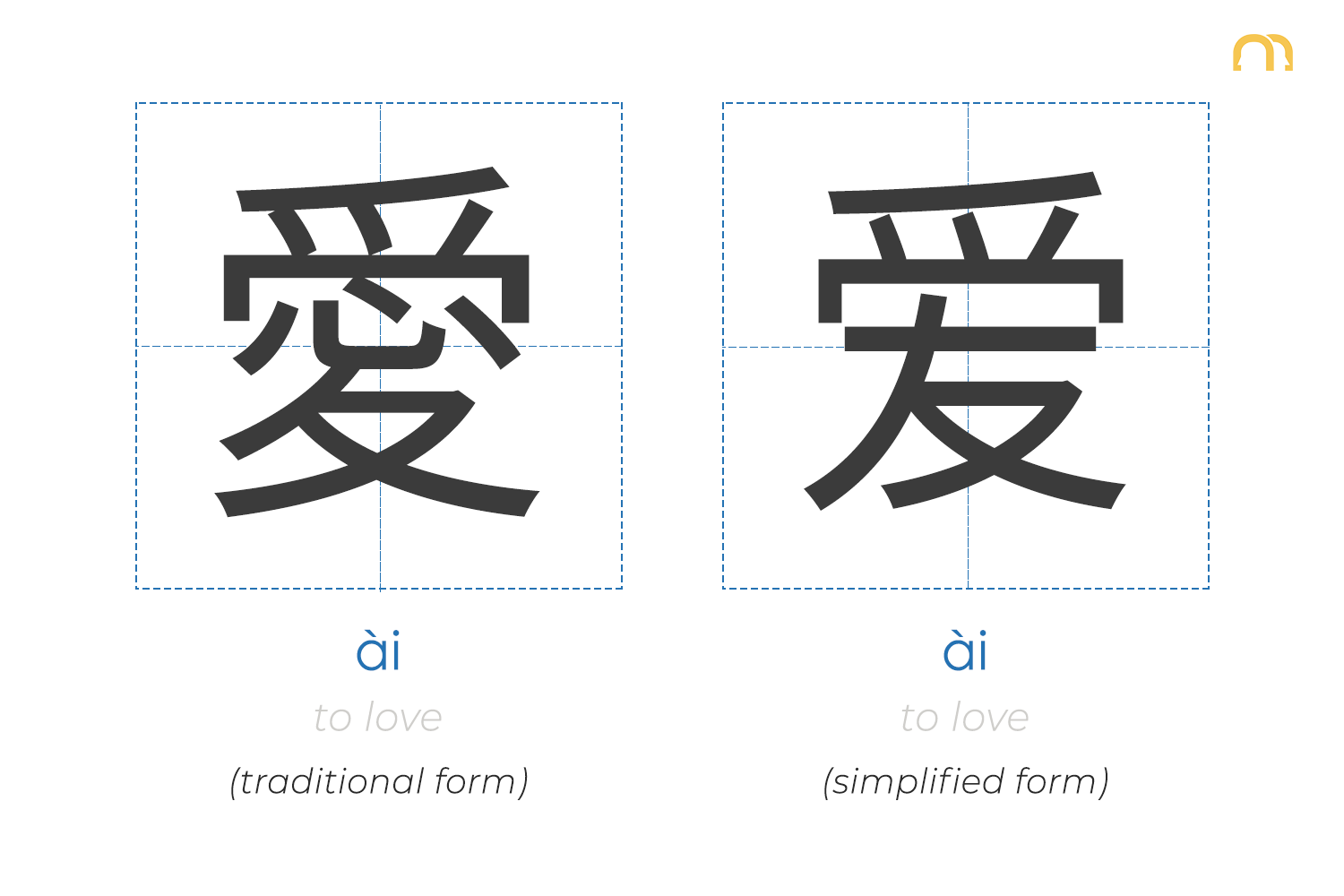
Mainland China primarily uses simplified Chinese characters (简体字), while Hong Kong and Macau traditionally use traditional Chinese characters (繁體字).
This is separate from the difference between Mandarin and Cantonese. In other words:
Mandarin vs. Cantonese = primarily a difference in language variety and spoken language.
Simplified vs. traditional Chinese = primarily a difference in writing system.
This distinction is useful for anyone deciding which form of Chinese to study.
Learn more about Chinese calligraphy in our dedicated guide here.
Major Chinese Language Varieties
Mandarin and Cantonese are probably the two Chinese varieties that international learners encounter most often, but they are only part of China’s wider linguistic landscape.
China is home to several major groups of Chinese language varieties, each with their own regional history, pronunciation and vocabulary.
Here are some of the most widely recognised groups.
Mandarin (官话)
Mandarin (官话, Guānhuà) is the largest Chinese language group and is spoken across a huge area of China.
It includes many regional varieties, including forms of Mandarin spoken in northern China, the southwest and parts of central China.
Standard Mandarin (普通话, Pǔtōnghuà) is based on the Mandarin group and provides a common spoken standard across mainland China.
Wu (吴语)
Wu Chinese (吴语, Wúyǔ) is mainly spoken around Shanghai, Zhejiang and parts of Jiangsu.
One of its best-known varieties is Shanghainese, which is spoken in and around Shanghai.
If you travel to Shanghai, you may hear both Standard Mandarin and local Wu varieties. While many local people are fluent in Mandarin, Shanghainese has its own pronunciation and vocabulary.
Yue / Cantonese (粤语)
Yue (粤语, Yuèyǔ) is the group that includes Cantonese.
It is mainly associated with:
- Guangdong
- Hong Kong
- Macau
- Overseas Chinese communities
Cantonese is particularly important in Hong Kong, where it remains widely used in everyday life.
Min (闽语)
Min (闽语, Mǐnyǔ) is a broad group of Chinese varieties associated particularly with Fujian Province and surrounding areas, as well as Taiwan and overseas Chinese communities.
Min includes several different varieties, so it isn’t simply one spoken language.
One familiar example is Hokkien, which is spoken in various forms in parts of southern China, Taiwan and Southeast Asia.
Hakka (客家话)
Hakka (客家话, Kèjiāhuà) is spoken by Hakka communities in different parts of southern China and around the world.
The Hakka have a long history of migration, which helps explain why Hakka-speaking communities can be found across different regions.
Like other major Chinese varieties, Hakka has its own pronunciation and vocabulary.
Gan (赣语)
Gan Chinese (赣语, Gànyǔ) is primarily associated with Jiangxi Province and neighbouring areas.
It is less familiar to international learners than Mandarin or Cantonese, but it is one of the major Chinese language groups traditionally recognised in discussions of China’s linguistic diversity.
Xiang (湘语)
Xiang Chinese (湘语, Xiāngyǔ) is mainly spoken in Hunan Province.
Like the other varieties discussed here, Xiang includes regional differences and has developed through a long history of interaction with neighbouring varieties.
A Quick Overview
| chinese variety | main areas |
|---|---|
| Mandarin | Northern, southwestern and many central/eastern areas |
| Wu | Shanghai, Zhejiang and parts of Jiangsu |
| Yue / Cantonese | Guangdong, Hong Kong and Macau |
| Min | Fujian, Taiwan and surrounding areas |
| Hakka | Southern China and overseas communities |
| Gan | Jiangxi and surrounding areas |
| Xiang | Hunan |
This is also why a simple map of “one language per province” would not accurately represent China’s linguistic landscape.
Which Chinese Language Should You Learn?
If you’re deciding which Chinese language to learn, the best choice depends on where you plan to use it and who you want to communicate with.
For most international learners, Standard Mandarin is the most practical starting point because it is the standard language used across mainland China and is widely taught around the world.
Learn Mandarin If…
Mandarin is a good choice if you want to:
- Travel widely throughout mainland China
- Study at a Chinese university
- Work in mainland China
- Communicate with people from different regions
- Build a broad foundation in spoken Chinese
- Access the largest range of Chinese learning resources
Learning Standard Mandarin also gives you a useful foundation for recognising regional differences when you encounter them.
Learn Cantonese If…
Cantonese may be a better choice if you:
- Live in Hong Kong
- Plan to spend significant time in Guangdong
- Have Cantonese-speaking family members
- Want to communicate with Cantonese-speaking communities
- Are particularly interested in Hong Kong or Cantonese culture and media
For someone living in Hong Kong, for example, learning Cantonese can be especially useful for everyday social interactions, even if they already know Mandarin.

Useful Chinese Language Vocabulary
If you’re learning Mandarin, understanding the vocabulary used to describe China’s different languages and dialects can make conversations about language much easier.
| chinese | pinyin | english |
|---|---|---|
| 中文 | Zhōngwén | Chinese language |
| 普通话 | Pǔtōnghuà | Mandarin |
| 语言 | yǔyán | language |
| 方言 | fāngyán | dialect / regional variety |
| 粤语 | Yuèyǔ | Cantonese |
| 口语 | kǒuyǔ | spoken language |
| 书面语 | shūmiànyǔ | written language |
| 发音 | fāyīn | pronunciation |
| 口音 | kǒuyīn | accent |
| 声调 | shēngdiào | tone |
| 汉字 | Hànzì | Chinese characters |
| 说 | shuō | to speak |
| 懂 | dǒng | to understand |
| 学 | xué | to learn |
Useful Phrases
你会说普通话吗?
Nǐ huì shuō Pǔtōnghuà ma?
Can you speak Mandarin?
你会说粤语吗?
Nǐ huì shuō Yuèyǔ ma?
Can you speak Cantonese?
你说什么方言?
Nǐ shuō shénme fāngyán?
What dialect do you speak?
你的普通话怎么样?
Nǐ de Pǔtōnghuà zěnmeyàng?
How is your Mandarin?