Tea has been part of Chinese life for centuries. From a simple cup served to a guest to carefully prepared tea ceremonies, it has become closely connected with Chinese food, hospitality and culture.
Chinese tea is known as 茶 (chá), while 茶文化 (chá wénhuà) means “tea culture”. The idea goes beyond the drink itself, covering how tea is grown, prepared, served and shared.
China is also home to a huge variety of teas. Green tea, oolong, black tea, white tea, yellow tea and dark tea all have different production methods, flavors and regional traditions.
For anyone learning Mandarin or interested in Chinese culture, tea offers an interesting way to explore both. In this guide, we’ll look at the history of Chinese tea, the main types of tea, traditional tea ceremonies and some of the customs that have developed around drinking it.
Key Takeaways
- 茶 (chá) is the Chinese word for tea.
- Chinese tea culture includes the preparation, serving and appreciation of tea.
- Tea has a long history in China and has developed alongside Chinese culture.
- The six main categories are green, black, oolong, white, yellow and dark tea.
- Chinese tea ceremonies focus on careful preparation, presentation and hospitality.
- Gongfu tea (功夫茶) is a well-known style of tea preparation, particularly in southern China.
What Is Chinese Tea Culture?
Chinese tea culture, or 茶文化 (chá wénhuà), covers much more than the simple act of drinking tea. It includes the way tea is grown, prepared and served, as well as the customs that have developed around it.
Tea can be part of everyday life in China. A pot of tea might be served when guests visit, shared during a meal or enjoyed while chatting with friends.
The way tea is prepared can also depend on the type of tea and the region. Some teas are simply brewed in a cup, while more formal settings may involve specific teaware and carefully controlled brewing.
Tea is also closely connected with ideas of hospitality and respect. Offering someone tea can be a simple way of welcoming them, while more formal tea traditions place greater emphasis on the preparation and presentation of the drink.
茶
chá
tea
A Brief History of Tea in China
Tea has a long history in China, with evidence of tea drinking and cultivation dating back centuries. Over time, it became much more than an everyday drink, developing into an important part of Chinese culture.
One of the most influential figures in the history of Chinese tea is Lu Yu (陆羽), a scholar from the Tang dynasty. He wrote the Classic of Tea (茶经, Chájīng), one of the earliest known books devoted entirely to tea.
The Tang dynasty was an important period for the development of tea culture. Tea became increasingly popular, and knowledge about growing, preparing and serving it began to spread.
During the Song dynasty, tea drinking became closely connected with art, literature and scholarly culture. Tea preparation could be an elaborate activity, with attention given to the quality of the tea, water and equipment.
The Ming dynasty brought another major change. Loose tea leaves became increasingly common, replacing some of the earlier traditions of preparing compressed tea. This helped shape the way tea is commonly brewed in China today.
The history of tea is closely tied to the wider history and traditions of Ancient China, making it a useful window into how Chinese culture developed over time.
The Six Main Types of Chinese Tea
Chinese tea is commonly divided into six main categories, based on how the tea leaves are processed.
| tea type | chinese | pinyin | general characteristics |
|---|---|---|---|
| green tea | 绿茶 | lǜchá | fresh and grassy |
| black tea | 红茶 | hóngchá | rich and full-bodied |
| oolong tea | 乌龙茶 | wūlóngchá | varied and partially oxidized |
| white tea | 白茶 | báichá | light and delicate |
| yellow tea | 黄茶 | huángchá | mild and relatively rare |
| dark tea | 黑茶 | hēichá | fermented and often earthy |

Green Tea
绿茶 (lǜchá) is one of the most widely enjoyed types of Chinese tea. It is minimally oxidised, giving it a fresh flavour.
Longjing (龙井, Lóngjǐng) is one of China’s best-known green teas.

Black Tea
Chinese black tea is called 红茶 (hóngchá), literally “red tea”. It is fully oxidised and tends to have a deeper, richer flavour.
Keemun tea (祁门红茶, Qímén hóngchá) is a well-known example.

Oolong Tea
乌龙茶 (wūlóngchá) is partially oxidised, giving it a wide range of flavours and aromas.
Tieguanyin (铁观音) and Da Hong Pao (大红袍) are two famous examples.
White Tea
白茶 (báichá) is lightly processed and is known for its delicate flavour. It is particularly associated with Fujian Province.

Yellow Tea
黄茶 (huángchá) is less common than many other Chinese teas. Its additional processing gives it a distinctive colour and relatively mild flavour.

Dark Tea
黑茶 (hēichá) undergoes fermentation or post-fermentation.
Pu’er tea (普洱茶, Pǔ’ěr chá) is one of the best-known types of dark tea.
Chinese Tea Ceremony
There isn’t one single Chinese tea ceremony followed across the country. Tea traditions vary between regions, types of tea and occasions.
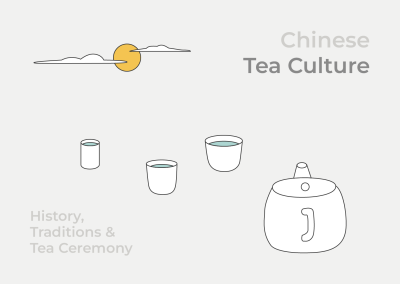
A traditional tea setting may involve choosing the tea, preparing the water, warming the teaware, brewing the leaves and serving the tea carefully.
Gongfu Tea Ceremony
功夫茶 (gōngfu chá) is a well-known style of tea preparation, particularly associated with Chaozhou and southern China.
It usually involves a small teapot or gaiwan, small cups and several short infusions of the same tea leaves.
Rather than making one large pot of tea, the tea is brewed in small amounts. This allows the flavor and aroma to develop across multiple infusions.
Gongfu tea is best understood as a style of careful tea preparation, rather than one fixed ceremony followed everywhere in China.
茶艺
cháyì
tea ceremony
Chinese Tea Traditions and Customs
Tea is often associated with hospitality and respect.
Offering tea to a guest can be a simple way of welcoming them, while tea may also be served during family gatherings and other social occasions.
Tea has a role in some traditional Chinese wedding ceremonies too, where couples serve tea to their parents and older relatives as a gesture of respect.
The exact customs vary between families and regions, so there is no single set of rules for every tea occasion.
Tea and Chinese Festivals
Tea can also be part of family gatherings and celebrations during Chinese festivals.
It may be served alongside food when relatives come together, particularly during occasions where hospitality and family connection are important. Tea is not a defining tradition of every Chinese festival, however. Customs differ between regions and families, so the way tea is served can vary widely.
For a broader look at traditional celebrations throughout the year, explore our guide to Chinese festivals.
Famous Chinese Teas
China has many regional teas, each with its own flavor, appearance and production methods.
| tea | chinese | region |
|---|---|---|
| Longjing | 龙井 | Zhejiang |
| Biluochun | 碧螺春 | Jiangsu |
| Tieguanyin | 铁观音 | Fujian |
| Da Hong Pao | 大红袍 | Fujian |
| Pu’er | 普洱 | Yunnan |
| Keemun | 祁门红茶 | Anhui |
Useful Chinese Tea Vocabulary
If you’re learning Mandarin, these words are useful for talking about tea and tea culture.
| english | chinese | pinyin |
|---|---|---|
| 茶 | chá | tea |
| 茶文化 | chá wénhuà | tea culture |
| 绿茶 | lǜchá | green tea |
| 红茶 | hóngchá | black tea |
| 乌龙茶 | wūlóngchá | oolong tea |
| 白茶 | báichá | white tea |
| 茶道 | chádào | tea ceremony |
| 茶叶 | cháyè | tea leaves |
| 茶壶 | cháhú | teapot |
| 茶具 | chájù | tea set / teaware |
| 泡茶 | pào chá | to brew tea |
A useful phrase when offering someone tea is:
请喝茶
Qǐng hē chá
Please have some tea.